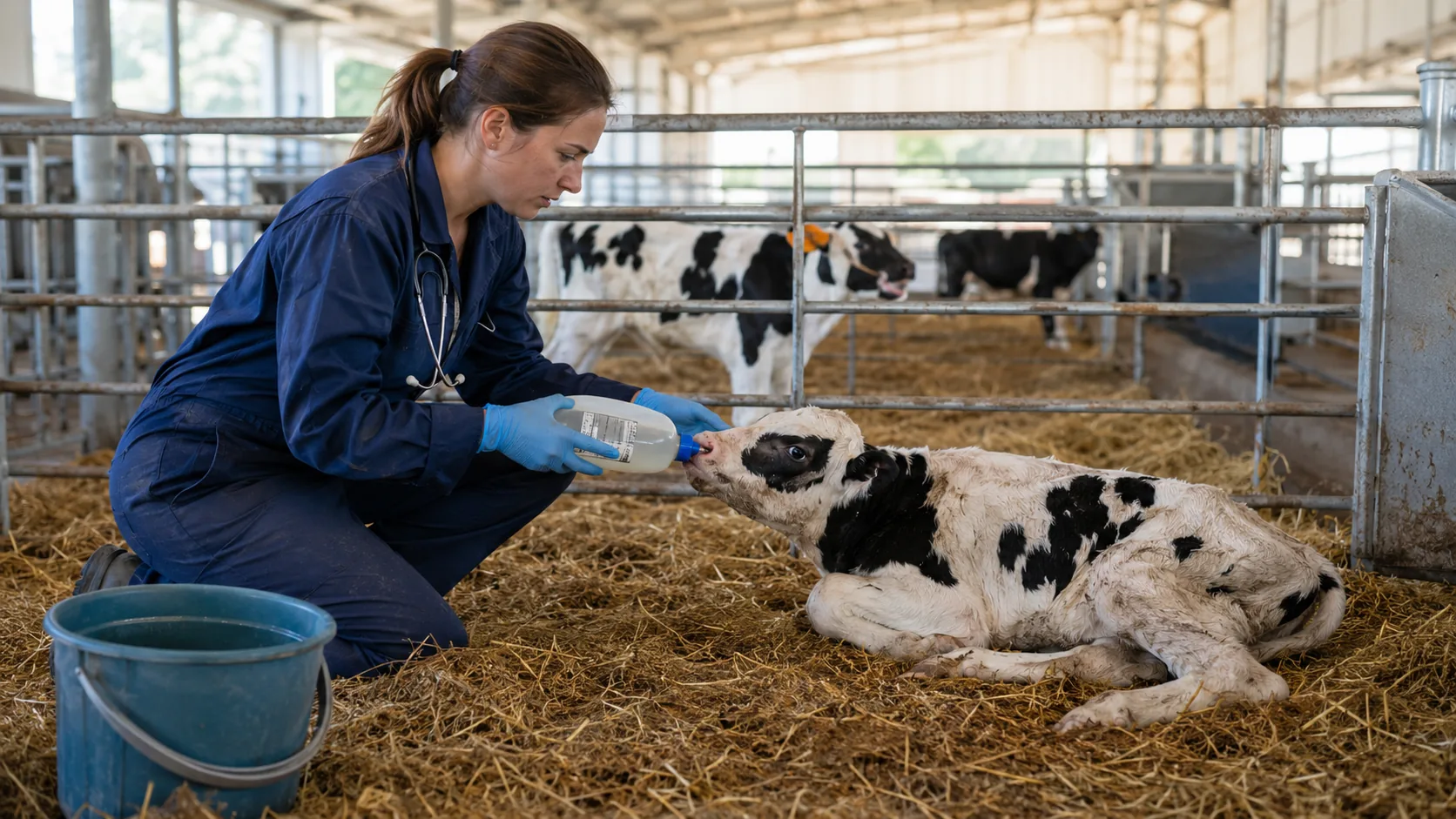
Calf diarrhea remains one of the major health challenges in rearing young cattle. Despite advances in prevention, biosecurity, and colostrum management, it still accounts for approximately 50–60% of all pre-weaning calf mortality.
However, this is only part of the problem. An increasing number of studies show that the consequences of diarrhea do not end when clinical symptoms subside. The disease can affect growth rates, the age at first calving, and milk yield achieved even two years later.
Why is diarrhea so dangerous?
In field practice, the greatest danger is not the change in stool consistency itself, but the loss of:
- water,
- electrolytes,
- energy,
- nutrients.
Young animals have limited energy reserves, so dehydration can progress very rapidly. Even moderate fluid loss leads to weakness, reduced milk intake, and slowed growth.
Who is most often responsible for diarrhea?
Contrary to popular belief, a veterinarian rarely deals with a single pathogen.
The most frequently identified infectious agents are:
Cryptosporidium parvum
The most frequently detected pathogen responsible for approximately 30–50% of cases of calf diarrhea.
Rotaviruses
They account for approximately 25–40% of cases, particularly in the first weeks of life.
Coronaviruses
Most frequently detected in approximately 10–20% of cases.
Enterotoxigenic E. coli strains
They account for approximately 5–15% of cases, particularly in the youngest calves.
Importantly, mixed infections occur in many herds, with *Cryptosporidium*, rotaviruses, and *E. coli* bacteria present simultaneously. Such cases typically run a more severe course and require more comprehensive support.
How much does a single bout of diarrhea cost?
Treatment costs are often only a small fraction of the total losses.
Studies show that calves that have suffered from diarrhea achieve lower daily weight gains—often 100–200 g less per day—than healthy animals.
In practice, this means:
- slower development,
- later achievement of insemination mass,
- extension of the rearing period.
Each additional day of rearing generates further costs associated with feeding and maintaining the animal.
Diarrhea today, less milk tomorrow
An increasing number of scientific publications point to a link between calf health and future production performance.
Heifers that suffered from severe diarrhea during the neonatal period:
- they often calve later,
- they reach a lower body weight before their first calving,
- they can produce anywhere from a few hundred to even over 1,000 kg less milk during their first lactation.
This means that the effects of diarrhea can be visible long after the rearing period has ended.
A rapid response is crucial.
In cases of diarrhea, the aim of management should be to simultaneously:
✔ reduction of digestive disorders
✔ fluid replenishment
✔ provision of electrolytes
✔ support for acid-base balance
✔ energy supply
✔ regeneration of the digestive tract
Comprehensive calf support from VetAnima
AnimaStop – support during the acute phase of diarrhea
AnimaStop provides pectins, electrolytes, energy, and vitamins. The product was developed to provide rapid support for calves during acute digestive disorders.
AnimaPect – support for gastrointestinal tract regeneration
Once the acute phase of diarrhea has stabilized, restoring proper intestinal function is crucial. AnimaPect provides substances that support the functioning of the digestive tract, as well as prebiotics, electrolytes, and nutrients.
AnimaLite and AnimaLite Liquid – hydration support
Effective management of diarrhea requires an adequate intake of fluids and electrolytes. Electrolyte preparations help mitigate the effects of dehydration and support the body during recovery.
Summary
Calf diarrhea is not only a health issue but also an economic one. It accounts for the majority of pre-weaning calf deaths, reduces weight gain, and can affect future milk production.
Therefore, effective management of this problem should encompass not only the treatment of symptoms but, above all, rapid rehydration, gastrointestinal support, and preventive measures to minimize the risk of the disease.